Abstract: Particle colliders have been the workhorse tool for particle physics since they were invented over 60 years ago. Forward particles are those...

May7
Quantum Supremacy: Checking a Quantum Computer with a Classical Supercomputer
John Martinis, U.C. Santa Barbara and Google
Monday, May 7, 2018
·
3:45 p.m.–5:00 p.m. PT
As microelectronics technology nears the end of exponential growth over time, known as Moore’s law, there is a renewed interest in new computing paradigms such as quantum computing. A key step in the roadmap to build a scientifically or commercially useful quantum computer will be to demonstrate its exponentially growing computing power. I will explain how a 7 by 7 array of superconducting xmon qubits with nearest-neighbor coupling, and with programmable single- and two-qubit gate with errors of about 0.2%, can execute a modest depth quantum computation that fully entangles the 49 qubits. Sampling of the resulting output can be checked against a classical simulation to demonstrate proper operation of the quantum computer and compare its system error rate with predictions. With a computation space of 2^49 = 5 x 10^14 states, the quantum computation can only be checked using the biggest supercomputers. I will show experimental data towards this demonstration from a 9 qubit adjustable-coupler “gmon” device, which implements the basic sampling algorithm of quantum supremacy for a computational (Hilbert) space of about 500. We have begun testing of the quantum supremacy chip.
About John Martinis
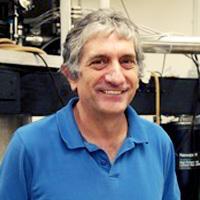
John Martinis attended U.C. Berkeley from 1976 to 1987. His PhD thesis was a pioneering demonstration of quantum-bit states in superconductors. After postdoctoral research at CEA in France, he joined NIST Boulder where he developed electron counting devices and x-ray microcalorimeters. In 2004 he moved to U.C. Santa Barbara where he continued work on quantum computation. In 2014 he was awarded the London Prize for low-temperature physics research. In 2014 he joined the Google quantum-AI team and heads the hardware effort to build a useful quantum computer.
Audience: Public


