Dec8
First Look with the Vera C. Rubin Observatory and the World's Largest Camera
Aaron Roodman, SLAC
Monday, December 8, 2025
·
4:30 p.m.–5:30 p.m. PT
Abstract:
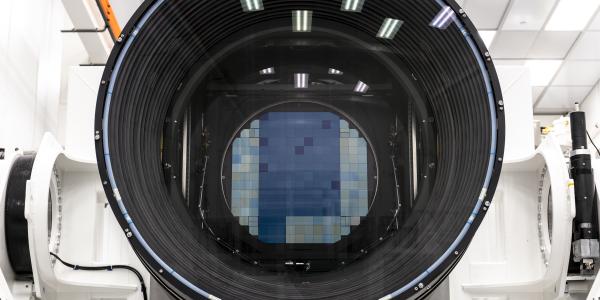
After over 20 years of planning, design, construction and commissioning the Vera C. Rubin Observatory is poised to begin its 10-year survey of the entire Southern Hemisphere sky. In this colloquium I’ll review the most important features and challenges of Rubin and especially of the 3.2 billion pixel LSST Camera, the world’s largest digital camera designed and built here at SLAC. To illustrate Rubin’s capabilities, I’ll give a guided tour of Rubin’s First Look images: the Cosmic Treasury with ten million stars and galaxies and the Swarm of Asteroids where over 4000 asteroids, more than 2000 of them newly discovered, were detected. Rubin is expected to observe 20 billion galaxies, 17 billion stars in the Milky Way, and over 6 million solar system objects. Every image Rubin takes will be delivered to SLAC’s S3DF computing facility for rapid comparison against previous images taken in that direction, and all changed objects, from supernova to asteroids, will be flagged, yielding between 1 and 10 million ‘alerts’ nightly. Images will also be combined, enabling the exploration of the deep universe and our galaxy, and studies of Dark Energy and Dark Matter. Finally, i will point to some of the first results from Rubin images and Rubin's future discovery potential.
About Aaron Roodman

Bio:
Aaron Roodman is a professor of Particle Physics & Astrophysics here at the SLAC National Accelerator Laboratory, specializing in observational cosmology. Trained in experimental particle physics, he spent two decades studying differences between Matter and antiMatter at both Fermilab and here at SLAC with the Babar experiment, before turning his research to astrophysics and cosmology initially with the Dark Energy Survey. He played a major role in the construction of the LSST Camera, the world's largest digital camera, and was the leader of the LSST Camera program and Deputy Director of the Rubin Observatory during its commissioning phase. Currently he is the Deputy Head of the Legacy Survey of Space Time as part of Rubin Observatory operations and his current research focuses on the study of Dark Energy via gravitational lensing.
Audience:


