Abstract: Particle colliders have been the workhorse tool for particle physics since they were invented over 60 years ago. Forward particles are those...

Mar2
Modern tests of Quantum Electrodynamics in the strong-field regime
Antonino Di Piazza, University of Rochester
Monday, March 2, 2026
·
4:30 p.m.–5:30 p.m. PT
Abstract: Quantum electrodynamics (QED) is a well-established physical theory and its predictions have been confirmed experimentally in various regimes and with extremely high accuracy. However, there are still areas of QED that deserve theoretical and experimental investigation, especially when physical processes occur in the presence of intense background electromagnetic fields, i.e., of the order of the so-called “critical” field of QED. After a broad introduction on strong-field QED and I focus on two prominent theoretical examples of currently open problems in the field: The problems of radiation reaction and that of vacuum polarization. Then, I will show how a newly-developed technology, “flying focus laser beams” (FFBs), can be employed as a tool to test QED in the strong-field regime and, in particular, its predictions on radiation reaction and vacuum polarization. In FFBs, in fact, the velocity of the focus can be “programmed” and it is independent of the group and the phase velocity of the beam itself. Specifically, by considering either an ultrarelativistic electron beam or a high-energy photon beam counterpropagating with respect to a FFB, whose focus copropagates with the electrons/photons at the speed of light, we show that radiation-reaction both in the classical and in the quantum regime as well as vacuum-polarization effects can be rendered measurable at much lower intensities than conventionally required in similar setups.
In the last part of the talk, I will describe the main features of a multipetawatt laser facility which is currently under design in Rochester: NSF OPAL.
About Antonino Di Piazza
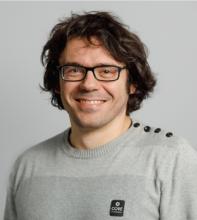
Bio: Professor Di Piazza received his Master (Laurea) in Theoretical Physics at the University of Palermo (Italy) in 2000, discussing a thesis on high-order harmonic generation in laser-atom interaction. He then moved to Trieste (Italy), where he received his PhD in Theoretical Physics in 2004 with a thesis on the production of electron-positron pairs and photons around black holes in the presence of time-dependent magnetic fields. From 2004 until 2023 he has worked at the Max Planck Institute for Nuclear Physics in Heidelberg (Germany) first as post-doc (from 2004 until 2008) and then as research group leader (from 2009 to 2023).
In 2011 Professor Di Piazza received the German habilitation and venia legendi at the Physikalisches Institut of the University of Heidelberg and in 2014 he received the Italian habilitation for full Professorship in Theoretical Physics of Fundamental Interactions.
Between 2012 and 2015 Professor Di Piazza served as Scientific Coordinator of the International Max Planck Research School for Quantum Dynamics in Physics, Chemistry and Biology (IMPRS-QD) at the Max Planck Institute for Nuclear Physics.
Audience:


