Abstract: Particle colliders have been the workhorse tool for particle physics since they were invented over 60 years ago. Forward particles are those...

Mar16
First Results from the JUNO Experiment
Juan Pedro Ochoa-Ricoux, University of California, Irvine
Monday, March 16, 2026
·
4:30 p.m.–5:30 p.m. PT
Abstract: Neutrinos are elusive particles with unique properties that offer key insights into the fundamental structure of matter and the cosmic sources that produce them. The Jiangmen Underground Neutrino Observatory (JUNO) is a next-generation, 20-kiloton liquid scintillator detector, the largest of its kind in the world, located in China and recently brought into operation after more than a decade of design and construction. In this talk, I will review the initial detector performance and present the first results from the experiment, based on about 60 days of data, which provide world-leading estimates of two neutrino oscillation parameters. I will also briefly outline the broader physics program enabled by JUNO and the additional measurements it aims to pursue.
About Juan Pedro Ochoa-Ricoux
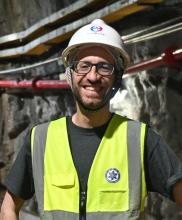
Bio: Juan Pedro Ochoa-Ricoux obtained his Ph.D. in Experimental Neutrino Physics from Caltech in 2010, after which he became a Chamberlain Fellow at Berkeley Lab. In 2013, he joined the faculty of the Physics Department at the Pontificia Universidad Católica de Chile, and in 2019 he joined the University of California, Irvine, where he is currently a professor. He specializes in accelerator and reactor neutrino experiments, and has also contributed to the ATLAS collider experiment at the Large Hadron Collider.
Audience:


