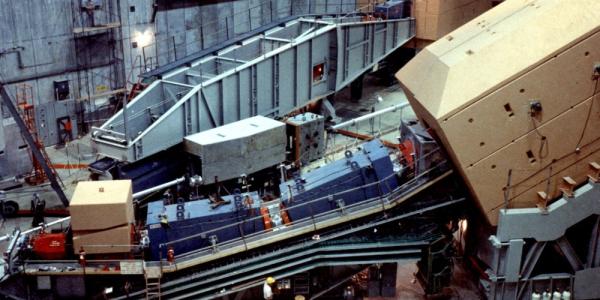
Abstract: I will describe my early experiences at SLAC, beginning in the late 60’s with the electron-proton scattering program which discovered point-like structure...

May11
Microelectronics: When the Enabler Becomes the Bottleneck
Professor Angelo Dragone, Stanford and SLAC
Monday, May 11, 2026
·
4:30 p.m.–5:30 p.m. PT
Abstract: Microelectronics spans a broad stack from materials and devices to circuits, architectures, and integrated systems, all of which are essential to modern scientific instrumentation. Across fields such as photon science and high-energy physics, advances in microelectronics have enabled new experimental capabilities, from highly segmented detectors to ultrafast, low-noise readout systems. However, as these systems scale, microelectronics increasingly defines the limits of what is possible. As next-generation facilities push toward extreme data rates, challenges in bandwidth, latency, and energy consumption shift attention toward how efficiently information is extracted from measured signals. This colloquium examines the role of microelectronics across these layers, with particular emphasis on circuits and architectures that govern data movement and system-level performance. Through representative examples, it illustrates how architectural choices in data reduction, processing, and control are being rethought to address emerging system-level constraints. The talk concludes by outlining opportunities for cross-layer co-design and key research challenges for future data-intensive scientific instruments.
About Professor Angelo Dragone
Bio: Angelo Dragone is an Associate Professor of Photon Science and Electrical Engineering (by courtesy) at Stanford University and a member of the SLAC faculty, where he leads detector and microelectronics research within the Technology Innovation Directorate at SLAC National Accelerator Laboratory. His team focuses on the design of mixed-signal circuits and architectures for high-rate, data-intensive systems, including ultrafast X-ray detectors and advanced sensor interfaces. His research interests span mixed-signal architectures for networks of sensors, edge-processing systems, and intelligent sensing platforms for real-time information extraction.
Audience:
In case you're interested