The Age of Human-Robot Collaboration: Deep-Sea Robotic Exploration
Dr. Oussama Khatib, Stanford University
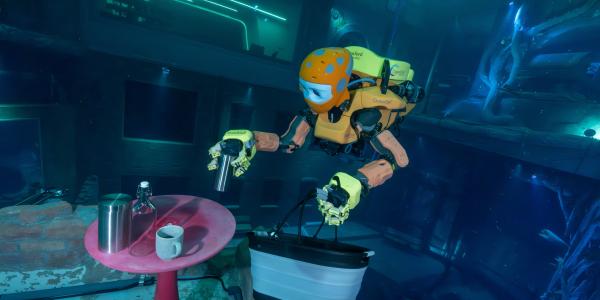
Abstract: OceanOne is a robotic diver with a high degree of autonomy for physical interaction with the marine environment. The robot’s advanced autonomous capabilities for physical interaction in deep-sea are combined with the cognitive abilities of a human expert through an intuitive haptic/stereo-vision interface. OceanOne was deployed in several archeological expeditions in the Mediterranean with the ability to reach 1000 meters and more recently the robot was tested in challenging tasks at Deep Dive Dubai. Distancing humans physically from dangerous
and unreachable spaces while connecting their skills, intuition, and experience to the task promises to fundamentally alter remote work. These developments show how human-robot collaboration-induced synergy can expand our abilities to reach new resources, build and maintain infrastructure, and perform disaster prevention and recovery operations - be it deep in oceans and mines, at mountain tops, or in space.
About Dr. Oussama Khatib

Oussama Khatib received his PhD from Sup’Aero, Toulouse, France, in 1980. He is Professor of Computer Science and Director of the Robotics Laboratory at Stanford University. His research focuses on methodologies and technologies in human-centered robotics, haptic interactions, artificial intelligence, human motion synthesis and animation. He is President of the International Foundation of Robotics Research (IFRR) and an IEEE Fellow. He is Editor of the Springer STAR and SPAR series, and Springer Handbook of Robotics. He is recipient of the IEEE Robotics and Automation, Pioneering Award, the George Saridis Leadership Award, the Distinguished Service Award, the Japan Robot Association (JARA) Award, the Rudolf Kalman Award, and the IEEE Technical Field Award. Professor Khatib is Knight of the National Order of Merit and a member of the National Academy of Engineering.
Audience:


