Abstract: I will describe my early experiences at SLAC, beginning in the late 60’s with the electron-proton scattering program which discovered point-like structure...
Apr20
Hope Versus Hype: Quantum, AI and the Path to Commercial Advantage
Dr. Matthias Troyer, Microsoft
Monday, April 20, 2026
·
4:30 p.m.–5:30 p.m. PT
Abstract:
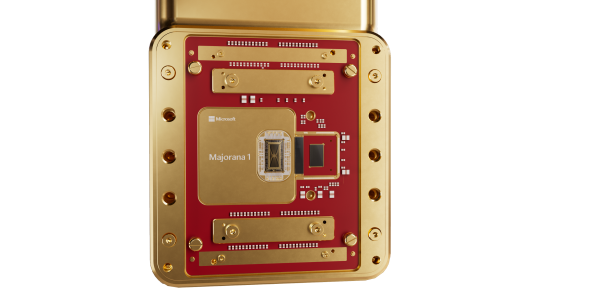
The promise of quantum is real, and we are beginning to see where this technology can have the greatest impact. Decades of quantum research and development point to one primary class of practical application for quantum computing next to cryptanalysis: the simulation of quantum systems, especially for chemistry and materials science. As we continue to improve the fidelity and scale of quantum machines, we will first be able to unlock scientific quantum advantage, solving a growing class of scientifically interesting and classically intractable problems. As we scale to quantum supercomputers, we will be able to achieve commercial quantum advantage and solve the world’s most pressing challenges through quantum-enabled advances in chemistry, biochemistry, and materials science. Yet scaled quantum systems won’t exist in isolation but will operate alongside AI and classical supercomputing. At Microsoft, we are today engineering these hybrid classical-quantum supercomputing systems with the goal of accelerating scientific discovery. Join us to learn more about the promising applications for quantum computing, our latest achievements, and our path to scale.
About Dr. Matthias Troyer

Bio: Matthias Troyer is Technical Fellow and Corporate Vice President at Microsoft, working on the system architecture of quantum computers and their applications. After receiving his PhD in 1994 from ETH Zurich in Switzerland and spending time as postdoc at the University of Tokyo he has been professor of Computational Physics at ETH Zurich until joining Microsoft in 2017. Matthias is a Fellow of the American Physical Society, President of the Aspen Center for Physics, and Board Member of the Elevate Quantum Tech Hub in the Mountain West. He is recipient of the Rahman Prize for Computational Physics of the American Physical Society “for pioneering numerical work in many seemingly intractable areas of quantum many body physics and for providing efficient sophisticated computer codes to the community” and of the Hamburg Prize for Theoretical Physics.
Audience:
In case you're interested