AI (R)evolutions in Observational Astronomy
Prof. Dovi Poznanski, Tel Aviv University | Visiting Professor, Stanford University
Abstract:
AI and machine learning have found applications in many fields, and astronomy is no exception. But while some see AI as an overhyped toy and others as an existential threat, astronomers have been using it for a while, out of necessity. With an overwhelming influx of data, these tools provide essential automation to facilitate discovery in observational astronomy. I will argue that multiple evolutions are underway, and at least one true Revolution.
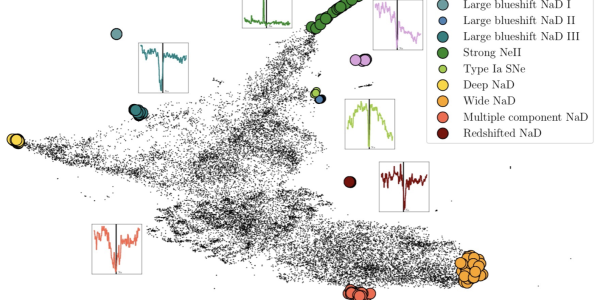
In this talk I will walk through a few of these evolutions: from early, rudimentary classifiers to the AI-driven brokers that now manage the firehose of transient alerts. I I will show how anomaly detection algorithms and self-supervised methods — capable of extracting patterns without labeled training data — are enabling meaningful discoveries in imaging, spectroscopic samples, and time series. I will also discuss what I see as a true Revolution: how the reasoning models that power chatbots are bound to affect society while reshaping how we do science.
About Prof. Dovi Poznanski

Dovi Poznanski is an astrophysicist from Tel Aviv University, and currently a Visiting Professor of Physics at Stanford. His research interests span many subjects, and include supernovae, galaxies and their interstellar medium, and supermassive black holes. The common threads between most of his works is the time domain, and in the use of Data-Science techniques, especially Machine Learning. In recent years his focus has been on enabling discovery in large datasets, by using and developing anomaly detection methods.
Audience:


