n-capture in inverse kinematics
Rene Reifarth, LANL, Los Alamos National Laboratory and Goethe University Frankfurt
Abstract:
Virtually all of the isotopes heavier than iron would not exist without neutron-induced reactions. Despite their importance in many different astrophysical scenarios, there are almost no direct measurements for isotopes with half-lives shorter than a few years. A radically new approach is necessary to overcome this constraint.
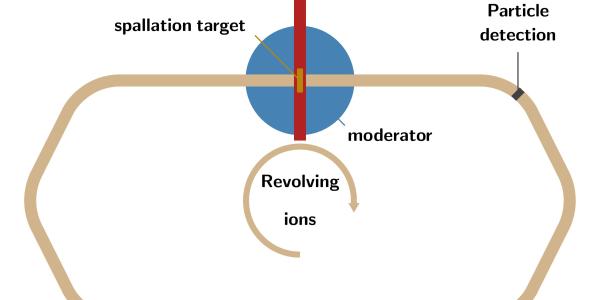
Ion storage rings offer unprecedented possibilities to investigate radioactive isotopes of astrophysical importance in inverse kinematics. During the last years, a series of pioneering experiments proved the feasibility of this concept for the fusion of charged particles at the Experimental Storage Ring (ESR) at GSI. In the future, a combination of a free-neutron target and an ion storage ring can bring the half-life limit for direct neutron-induced reactions down to fractions of a minute.
I will review different astrophysical scenarios, status of current experiments as well as prospects of this new experimental endeavor.
About Rene Reifarth, LANL

Rene Reifarth received his PhD at the Karls University of Tuebingen, Germany. He is a scientist at the Los Alamos National Laboratory, US and Professor at Goethe University Frankfurt, Germany. His research is focused on experimental approaches determining nuclear reaction rates important for different astrophysical scenarios.
Audience:


