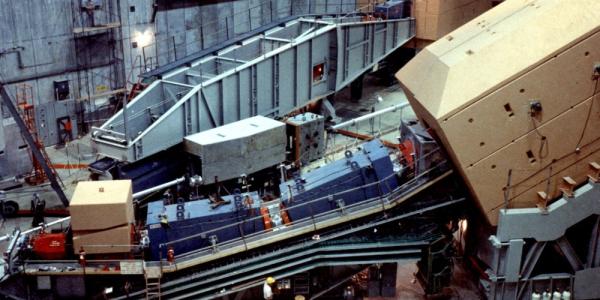
Abstract: I will describe my early experiences at SLAC, beginning in the late 60’s with the electron-proton scattering program which discovered point-like structure...

May4
Chasing cosmic acceleration with galaxies: From the Dark Energy Survey to the Rubin Observatory
Dr. Agnes Ferte, SLAC
Monday, May 4, 2026
·
4:30 p.m.–5:30 p.m. PT
Abstract:
The origin of cosmic acceleration remains an open question: is it caused by a dark energy and if so, what are its properties? Or is our theory of gravity incomplete on the largest scales? These questions have driven an ambitious effort from the cosmology community to develop wide galaxy surveys. I will first explain how galaxies are indeed a powerful way to test cosmology, focusing on the weak lensing effect. I will then present the newest results on our understanding of the Universe and dark energy from the completed Dark Energy Survey (DES), which produced the largest weak lensing catalog to date. The methods and results the DES collaboration has developed over the past decade set the scene for the new generation of galaxy surveys such as the LSST by the Vera C. Rubin Observatory. I will update on the status of the Rubin Observatory and end with the challenges we will need to solve to test dark energy and gravity with its future weak lensing measurements.
About Dr. Agnes Ferte

Bio: I am a Rubin scientist at SLAC/KIPAC, studying dark energy and gravity using large-scale galaxy surveys. After earning my PhD from Université Paris-Sud, I joined the Dark Energy Survey collaboration to test cosmology with galaxies during my postdoctoral position at the Royal Observatory, Edinburgh. I then further advanced this research at the Jet Propulsion Laboratory in Pasadena, CA. In 2022, I joined SLAC and have since then been participating in the efforts to produce the final results from the Dark Energy Survey, as well as contributing to the calibration of the Vera C. Rubin Observatory and preparing for its tests of gravity at cosmic scales.
Audience:
In case you're interested